
Sonic Pico Park How to Play: Rules, Roles and First Steps
Learn the goal-plate rule, Spin Dash, rings, flight and co-op roles before your first Sonic Pico Park session. A practical start guide for 2-8 players.
SONIC PICO PARK has one rule: every player must touch the goal plate at the end of the stage. Not one player, not the fastest player, and not the host. The whole group. Everything else in the game, from the Spin Dash to the flight characters, exists to get a scattered group of two to eight players to the same plate at the same time.
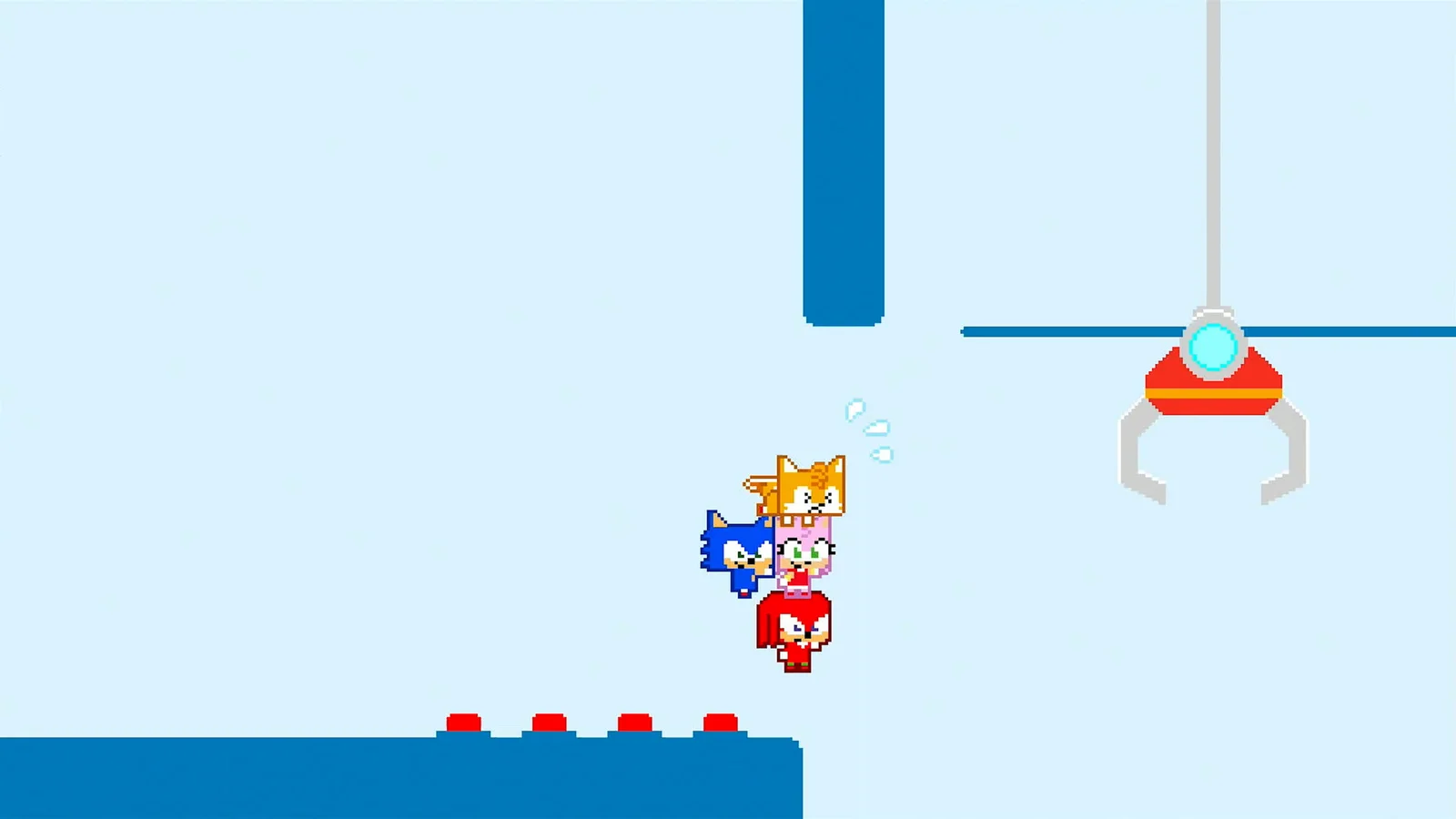
That single rule explains most of the frustration new groups feel. A player who reaches the plate early is not helping; they are waiting. A player who falls behind is not a failure; they are the reason the room is not finished. The game is a coordination problem dressed as a platformer.
Two players minimum, one screen or one lobby, everyone in the same voice channel, and a agreement that nobody touches the plate until the group is ready.
The basic rules
| Rule | What it means in practice |
|---|---|
| Every player must reach the goal plate | The stage does not end until all active players touch it |
| Two to eight players | There is no single-player mode and no bot fill |
| Shared screen | Players cannot split up across a level; the camera keeps the group together |
| No lives to manage | A fall sends you back to the last checkpoint rather than ending the run |
| Characters are tools | Flight, glide, and ground characters solve different rooms |
The shared screen is the most important constraint. In a online lobby, every player sees the same camera view. If one player runs ahead, the camera follows the group, and the straggler can be pushed off-screen. The game expects the group to move as a unit, not as eight independent platformer players.
The four actions that matter
Move and jump
Movement is the baseline. Every character jumps to the same height, so a jump that works for Sonic works for Big. The differences are in the special actions, not in the basic platforming.
Spin Dash
The Spin Dash is the Sonic mechanic that changes the most rooms. The game prompts it early with an on-screen direction input, and the move works like the classic version: charge in place, release, and launch forward at speed.
The dash has three uses:
- Breaking cracked blocks. Worlds 4, 6, and 7 use cracked block walls that only open to a Spin Dash.
- Hitting enemies. The green Badniks in World 12 and the hazards in later worlds can be cleared with a dash.
- Crossing gaps. A charged dash covers more distance than a jump, which matters on the rails and ramps in World 10.
The dash is also the easiest way to throw yourself into a pit. Charge it on a ledge with no run-out and you will launch straight into the gap. The safe habit is to charge away from the edge, then release toward the target.
Flight and glide
Flight characters can carry one teammate across a gap. The game shows a stop-flight prompt while airborne, and the flight has a limited duration. Two passengers are too many for most gaps; the carry is a one-person taxi, not a group elevator.
Glide characters work differently. A glide is a controlled descent, not a lift. It covers horizontal distance while losing height, and it is the right tool for a gap that ends lower than it starts. Using a glide to reach a higher platform does not work.
Rings
Rings are both a collectible and a key. Some gates open only while a player is holding enough rings, and the ring counters in Worlds 8, 9, and 11 make the count part of the puzzle. The game also teaches a ring-sharing prompt in World 1-3, where a Spin Dash into a teammate is tied to the ring economy.
The practical rule for new groups: do not spend the group's rings on a gate until you know what is on the other side. A gate that closes behind you can strand the players who did not make it through.
Your first fifteen minutes
- Start in World 1 with the full group. Do not let one experienced player scout ahead. The first world teaches the goal-plate rule, the Spin Dash, the loop, and the flight carry in four short stages.
- Let the prompts teach. The game prints short instructions on screen, including the Spin Dash direction, the stop-flight button, the glide hold, and the rail dismount. Read them out loud if your group is not looking at the same screen.
- Assign a caller. One player counts the group at each checkpoint and calls the plan. In an eight-player lobby, two people talking over each other is the normal failure state.
- Pick characters for the room, not for favorites. A flight character is close to mandatory in rooms with a wide gap. A ground character with a strong dash is better in a cracked-block room.
- Finish the world before you chase stars. The world-select screen tracks clears and stars. Cleaning up missed stars is easier once the group knows the world's mechanics.
The World 1 guide → walks through the four opening stages and the exact lessons each one teaches.
How a stage usually plays out
A typical Sonic Pico Park room follows a four-beat structure:
- Read the room. The camera shows the whole puzzle before anyone moves. Identify the goal plate, the hazard, and the one mechanic the room is built around.
- Assign the job. Who breaks the block, who flies, who holds the ring gate, who waits at the plate. A room with no assigned jobs becomes eight people doing the same thing.
- Execute the fragile part. The fragile part is usually a carry, a stack, or a timed gate. Send the minimum number of players into it and keep the rest clear.
- Regroup at the plate. Count the players before the last touch. The stage does not end until everyone is there, and a premature touch can leave someone behind a closing gate.
Common first-session mistakes
- Touching the plate early. The stage waits for everyone, so an early touch only creates confusion.
- Stacking without a caller. A stack of four players collapses when the bottom player moves. One player should call the count and the direction.
- Using flight as a group lift. Flight carries one passenger. Sending two players with the flyer drops both.
- Ignoring the checkpoint flag. A fall resets to the last checkpoint, not the start. Touching the flag is free progress.
- Charging the Spin Dash near a ledge. The dash is fast enough to carry you off the platform before you release it.
- Splitting the group in a shared-screen lobby. The camera does not follow the straggler, and the straggler cannot see the plan.
Local versus online first sessions
Local play is the better first session. Everyone sees the same screen, the lag is zero, and the shouting is immediate. Online play adds a lobby, a host, and connection quality to the list of things that can go wrong.
If you have to start online, use the platform's party chat and have the host open the lobby before inviting. The online setup guide → covers invites and connection fixes. The local co-op guide → covers controller assignments for eight players in one room.
Official source: SONIC PICO PARK official site ↗
Official source: Steam store page ↗
The Nintendo product page ↗ confirms the two-to-eight player range and the local and online modes. Siliconera's review ↗ explains how the Sonic mechanics change the PICO PARK formula. MonsterVine ↗ describes the room-by-room pacing.
FAQ
Can you play Sonic Pico Park solo?
No. The game requires at least two players. There is no single-player mode and no bot teammates.
How many players can play Sonic Pico Park?
Two to eight players, locally or online. Crossplay is supported between all platforms.
What is the goal in Sonic Pico Park?
Reach the goal plate at the end of each stage with every player. The stage does not clear until all active players touch it.
How do you Spin Dash?
The game prompts the input on your platform. Charge the dash in place, then release to launch forward. It breaks cracked blocks and hits enemies.
Do you need PlayStation Plus or Switch Online?
Only for online play on those consoles. Local play does not require a subscription.